
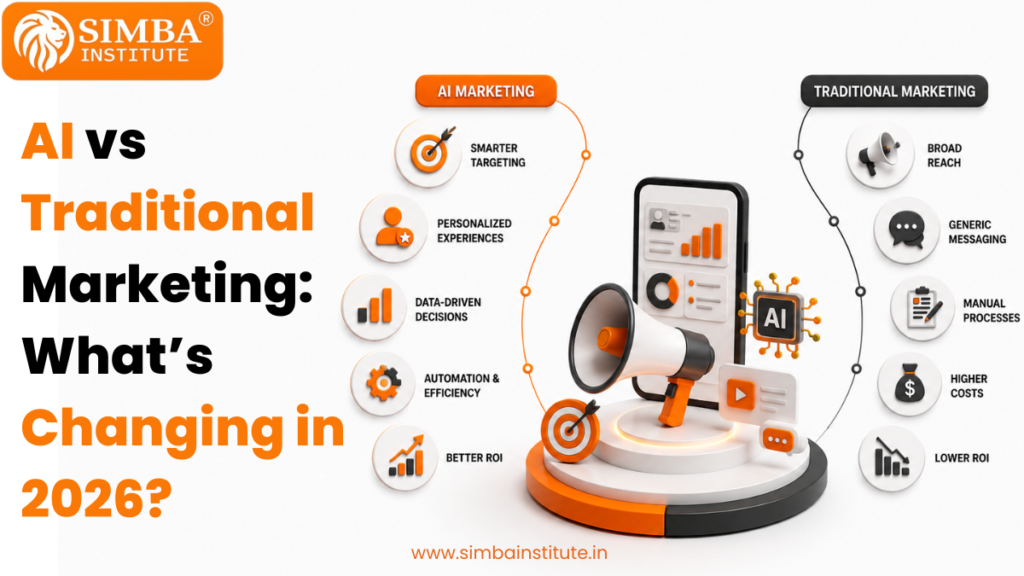
If you’ve been following digital marketing trends, you’ve probably noticed a lot of talk about AI changing everything. But what does that actually mean in practice? Is traditional digital marketing becoming outdated, or is AI simply changing how the same work gets done?
This is one of the most common questions students and business owners ask when they start exploring digital marketing in 2026. In this blog, we’ll break down the real differences between AI-powered and traditional digital marketing, what’s actually changing, and what stays the same no matter how much technology evolves.
What Is Traditional Digital Marketing?
Traditional digital marketing refers to the manual, hands-on approach marketers have used for years, writing content from scratch, manually researching keywords, testing ad campaigns one variation at a time, and analyzing performance through spreadsheets and reports.
This approach still works, but it’s slower and requires significantly more time and effort to get the same results that AI-assisted marketing can now achieve much faster.
This is exactly where AI is changing the game. Small businesses across Surat are now using AI tools to do the work that used to require a full marketing team creating content, running smarter ads, and understanding customers, without needing a big budget or technical expertise.
In this blog, we’ll look at how Surat’s small businesses are actually using AI in their day to day digital marketing, and what this shift means for anyone running or planning to grow a local business.
This blog breaks down the top 5 AI tools every digital marketer should know how to use in 2026, why each one matters, and how they fit into a real, practical marketing workflow whether you’re a student learning digital marketing or already working in the field.
What Is AI-Powered Digital Marketing?
AI-powered digital marketing uses AI tools to handle the repetitive, time-consuming parts of marketing work, generating content drafts, analyzing large amounts of data quickly, optimizing ad campaigns automatically, and identifying patterns that would take much longer to spot manually.
Importantly, AI-powered marketing doesn’t remove the marketer from the process. It changes their role from doing everything manually to guiding, reviewing, and improving what the AI produces.
What’s Actually Changing in 2026
Speed of Execution
What used to take a full day, writing a week’s worth of social media captions, for example, can now be drafted in AI tools within minutes, leaving more time for strategy, editing, and creative thinking.
How Campaigns Are Optimized
Traditional marketing relied on manually testing one ad variation at a time and waiting days for results. AI-powered ad tools now test multiple variations simultaneously and automatically shift budgets toward what’s performing best, in real time.
How Data Is Understood
Instead of manually going through analytics reports, marketers can now use AI tools to get clear, summarized insights instantly, making it easier to make fast, informed decisions rather than spending hours interpreting raw numbers.
The Marketer’s Day-to-Day Role
The biggest shift isn’t that marketers do less, it’s that they spend less time on repetitive tasks and more time on strategy, creativity, and decision-making, which are things AI still can’t do as well as an experienced marketer.
What Isn’t Changing
Despite all these changes, some core parts of digital marketing remain exactly as important as before:
- Understanding the audience: AI can help analyze data, but knowing what actually resonates with a specific audience still requires human judgment and market understanding.
- Brand voice and creativity: AI-generated content still needs a human touch to sound authentic and match a brand’s unique personality.
- Strategy and decision-making: AI can provide insights and suggestions, but deciding what to actually do with them is still a human responsibility.
- Building trust with customers: relationships, tone, and genuine communication still matter just as much as they always have.
AI vs Traditional: Which One Should You Learn?
This isn’t really an either-or choice. The marketers who succeed in 2026 aren’t choosing between AI and traditional digital marketing, they’re combining both. Traditional marketing fundamentals teach you why something works, while AI tools help you execute that strategy faster and more efficiently.
Someone who only knows traditional methods will work slower than competitors using AI. Someone who only knows AI tools without understanding marketing fundamentals will struggle to make good strategic decisions. The real advantage comes from knowing both.
How This Affects Your Career Choice
If you’re planning a career in digital marketing, this shift means one thing clearly: learning digital marketing without learning AI tools alongside it puts you at a disadvantage before you even start applying for jobs. Employers aren’t choosing between candidates who know “traditional” or “AI” marketing, they’re choosing candidates who understand both and know how to use them together.
How Simba Institute Prepares You for This Shift
At Simba Institute, our Digital Marketing + AI Tools course is built around this exact reality, teaching students the marketing fundamentals that never go out of date, alongside hands-on training in the AI tools that are now expected in almost every digital marketing role.
With branches in Sarthana and Vesu, and a track record since 2015, we focus on making sure students graduate with both the strategic thinking and the practical AI skills that today’s employers are actually looking for.
FAQs: AI vs Traditional Digital Marketing
1. Is AI digital marketing completely different from traditional digital marketing? Not completely. AI-powered digital marketing uses the same core principles as traditional marketing, but uses AI tools to execute tasks faster and analyze data more efficiently.
2. Should I learn traditional digital marketing or AI tools first? It’s best to learn them together. Understanding marketing fundamentals helps you use AI tools more effectively, rather than relying on them without knowing why a strategy works.
3. Will AI eventually replace the need to learn digital marketing fundamentals? No, fundamentals like audience understanding, strategy, and brand voice remain essential. AI tools support these skills, but they don’t replace the need to understand marketing itself.
4. Do employers prefer candidates who know AI tools over traditional marketing skills? Employers prefer candidates who know both. AI tool knowledge alone, without marketing fundamentals, is not enough to make good strategic decisions.
5. Is it too late to learn digital marketing because of how much AI has changed it? No, it’s actually a good time to start, since combining foundational marketing knowledge with AI tools from the beginning gives you a stronger, more complete skill set than marketers who learned only traditional methods years ago.