
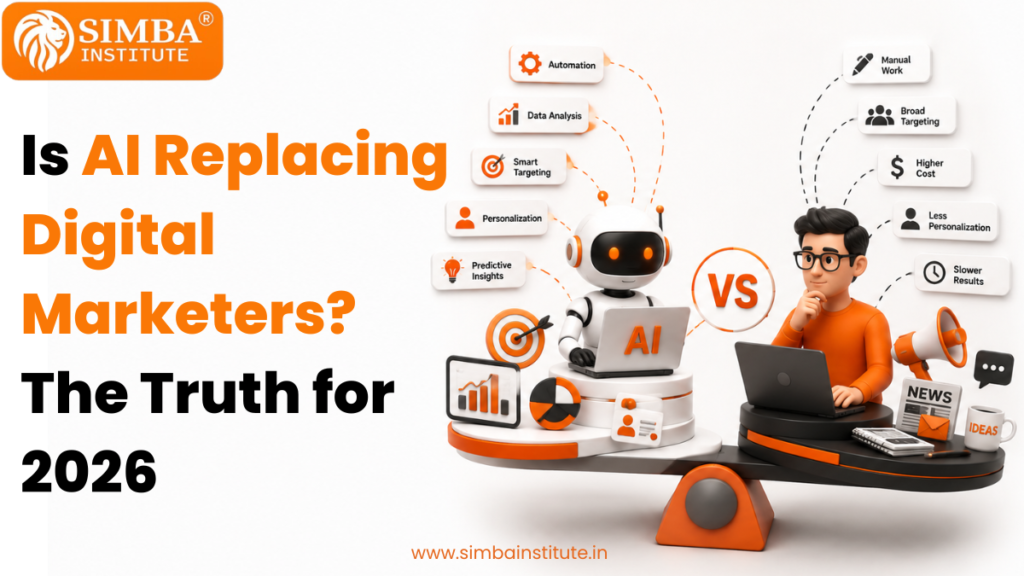
If you’re a student considering a career in digital marketing, or someone already working in the field, you’ve probably had this thought at some point: “With AI doing so much now, will there even be jobs for digital marketers in the future?”
It’s a fair question, and one that comes up constantly in comment sections, career counseling conversations, and classrooms. The honest answer isn’t a simple yes or no. In this blog, we’ll break down what AI can actually do, what it still can’t, and what this really means for your career in 2026 and beyond.
Why This Question Feels So Real Right Now
AI tools can now write content, generate ad creatives, analyze data, and optimize campaigns — tasks that used to require an entire marketing team. Seeing AI do in seconds what used to take hours naturally makes people wonder if the human marketer is becoming unnecessary.
But this fear isn’t new. Similar concerns came up when automation tools first entered marketing, when social media platforms changed how brands reached customers, and when analytics tools replaced manual reporting. Each time, the role of a marketer changed — it didn’t disappear.
What AI Can Actually Do Well
To answer the question honestly, it helps to look at what AI is genuinely good at in digital marketing today:
- Producing content quickly — first drafts of captions, blogs, and ad copy in minutes instead of hours.
- Analyzing large amounts of data — spotting patterns and trends in campaign performance faster than manual analysis.
- Optimizing ads automatically — testing multiple variations and shifting budget toward what performs best.
- Creating basic designs and videos — generating quick creatives without needing a dedicated design team.
These are real, valuable capabilities. There’s no point denying that AI has made certain tasks significantly faster and easier.
What AI Still Can’t Do
Despite these strengths, there are core parts of digital marketing that AI still struggles with, and likely will for a long time:
Understanding Context and Nuance
AI can generate content, but it doesn’t truly understand a brand’s history, values, or the specific emotional tone that resonates with a particular audience. That understanding still comes from a human marketer who knows the brand and the people it’s speaking to.
Making Strategic Decisions
AI can provide data and suggestions, but deciding what a business should actually prioritize, which audience to target, which message to lead with, when to pull back on a campaign still requires human judgment based on business goals, not just numbers.
Building Genuine Relationships
Marketing isn’t just about producing content; it’s about building trust with an audience over time. That kind of authentic connection still relies on human creativity and communication, not automated output.
Adapting to Local and Cultural Context
Especially in a market like Surat, understanding local customer behavior, festivals, language nuances, and cultural context is something AI tools still can’t replicate accurately without human guidance.
So, Is AI Replacing Digital Marketers?
The honest truth: AI isn’t replacing digital marketers, but it is replacing digital marketers who refuse to learn how to use it. The marketers being affected negatively aren’t losing their jobs to AI directly; they’re losing out to other marketers who use AI to work faster, smarter, and deliver better results.
In other words, the risk isn’t AI itself, it’s falling behind marketers who’ve learned to work alongside it.
What This Means for Your Career in 2026
If you’re starting a career in digital marketing now, this is actually good news. You’re not entering a field that’s shrinking — you’re entering one that’s evolving, with new tools that can make you significantly more effective than marketers who came before AI existed.
The key is making sure you don’t learn digital marketing without also learning how to use AI tools as part of your everyday work. Employers aren’t looking for marketers who avoid AI, and they’re not looking for people who rely on AI without understanding marketing fundamentals either — they want both.
How Simba Institute Prepares You for This Reality
At Simba Institute, our Digital Marketing + AI Tools course is designed around this exact truth — helping students build strong marketing fundamentals while becoming genuinely comfortable using AI tools as part of their daily workflow, not as an afterthought.
With branches in Sarthana and Vesu, and a track record since 2015, we focus on preparing students for the digital marketing industry as it actually exists today, not how it looked a few years ago.
Final Thoughts
AI isn’t taking away the future of digital marketing, it’s reshaping it. The marketers who will struggle in the coming years aren’t the ones working alongside AI; they’re the ones who ignore it and keep working the old, slower way while everyone else moves faster.
If you’re planning a career in this field, the real question isn’t “will AI replace me?” It’s “am I learning the skills that will make me impossible to replace?” And that answer lies in combining solid marketing fundamentals with genuine, hands-on comfort using AI tools, not choosing one over the other.
FAQs: AI and the Future of Digital Marketing Jobs
1. Will AI completely replace digital marketing jobs in the future?
No, AI is changing how digital marketing work gets done, but strategy, creativity, and human judgment remain essential parts of the job that AI cannot fully replace.
2. Should I still choose digital marketing as a career because of AI?
Yes, digital marketing remains a strong career choice. Learning to use AI tools alongside marketing fundamentals actually makes you more valuable to employers, not less.
3. What skills should I focus on to stay relevant as AI grows?
Focus on both marketing fundamentals (strategy, audience understanding, content planning) and practical AI tool skills, since employers want candidates who can combine both effectively.
4. Are entry-level digital marketing jobs at risk because of AI?
Entry-level roles are changing rather than disappearing. Candidates who understand how to use AI tools alongside basic marketing skills are generally more competitive for these roles, not less needed.
5. How can I make sure AI doesn’t replace my digital marketing career?
Stay consistently updated with new AI tools, keep strengthening your strategic and creative thinking, and make sure you’re using AI to enhance your work rather than avoiding it altogether.