simbainstitute

+91 8200533835
Inquire Now
Confused which course to choose? Talk to our experts for FREE & find the right path for your career — Inquire Now!
Mega Dropdown Courses

Computer Training Course in Surat

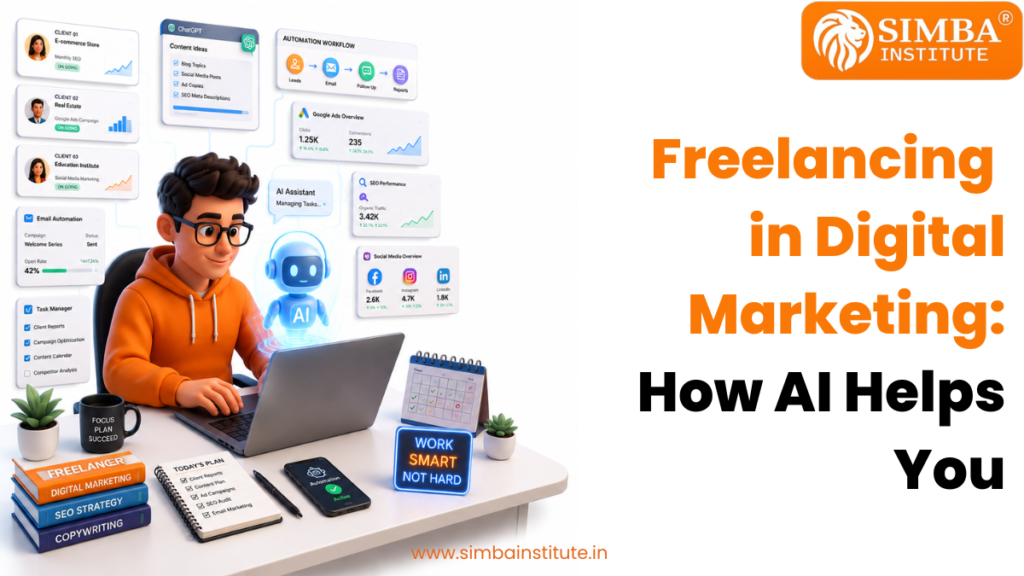
Freelancing has become one of the most popular paths for digital marketers, offering flexibility, independence, and the ability to work with multiple clients instead of being tied to a single company. But there’s always been one major challenge with freelancing: your time is limited, and taking on more clients usually means more hours of work. AI has started to change this equation. In 2026, digital marketing freelancers are using AI tools to manage more clients without burning out, handling tasks that used to eat up hours in a fraction of the time. This blog looks at how freelancers are actually using AI to grow their client base and income, without sacrificing quality.   Why Freelancing in Digital Marketing Makes Sense in 2026 Digital marketing is one of the most freelance-friendly fields available today. Businesses of all sizes, from local shops in Surat to companies across India need help with content, ads, and social media, but many don’t need or can’t afford a full-time, in-house marketer. This creates consistent demand for freelancers who can manage these tasks independently. And with AI tools now handling much of the repetitive work, freelancers can take on more clients than would have been realistically possible even a couple of years ago. The Biggest Challenge Freelancers Face The core challenge of freelancing has always been the same: time. Every additional client means more content to write, more campaigns to manage, and more reporting to handle, and there are only so many hours in a day. This is exactly where many freelancers hit a ceiling. They either have to charge higher rates to compensate for limited capacity, or they simply can’t take on new clients without working unsustainable hours. AI tools are directly addressing this limitation. How AI Helps Freelancers Manage More Clients Speeding Up Content Creation Across Multiple Accounts Writing captions, blog posts, and ad copy for one client is manageable. Doing it for five or six clients at once, each with a different brand voice, becomes overwhelming fast. AI writing tools help freelancers generate strong first drafts quickly for each client, which can then be personalized to match each brand’s specific tone. Managing Multiple Campaigns More Efficiently AI-powered ad tools can automatically test and optimize campaigns across different client accounts, reducing the amount of manual monitoring and adjustment freelancers need to do for each individual client. Creating Client Reports Faster Reporting is one of the most time-consuming, least enjoyable parts of freelancing — but it’s essential for client trust and retention. AI-powered analytics tools can summarize campaign performance clearly and quickly, helping freelancers put together professional reports for multiple clients without spending hours on each one. Staying Organized with AI-Assisted Planning Managing content calendars, deadlines, and deliverables across multiple clients can quickly become chaotic. AI tools can help freelancers plan and organize content schedules more efficiently, reducing the mental load of tracking everything manually. Creating Visuals Without a Design Team Freelancers rarely have access to a dedicated designer for every client. AI-based design tools allow freelancers to create professional-looking graphics and creatives quickly, across multiple brands, without needing advanced design skills or hiring outside help. What This Means for Freelance Income By reducing the time each client takes to manage, AI tools allow freelancers to take on more clients within the same working hours — directly increasing potential income without proportionally increasing workload. It also allows freelancers to deliver faster turnaround times, which can be a strong selling point when working with clients who expect quick results. What AI Can’t Do for Freelancers While AI helps significantly with execution, the parts of freelancing that build long-term client relationships still depend on the freelancer themselves: Understanding each client’s unique goals and challenges — AI can support execution, but understanding what actually matters to a specific business still requires direct communication and judgment. Building trust through consistent communication — clients stay with freelancers they trust, and that trust is built through reliability and genuine understanding, not automated output. Making strategic decisions for each client — every business is different, and deciding the right approach for each one still requires human thinking, not just AI suggestions. Getting Started as an AI-Powered Freelancer If you’re considering freelancing in digital marketing, here’s a simple way to approach it: Build strong marketing fundamentals first — freelancing without a solid understanding of strategy makes it difficult to deliver real results for clients. Learn to use AI tools alongside your core skills — practice using AI for content, design, and reporting so you can work efficiently from the start. Start with a manageable number of clients — build your systems and workflow before scaling up to a larger client base. Use AI to handle repetitive tasks, not client relationships — keep communication and strategy personal, even as execution becomes faster. How Simba Institute Prepares You for Freelancing Success At Simba Institute, our Digital Marketing + AI Tools course gives students the practical skills needed to freelance confidently — combining core marketing fundamentals with hands-on AI tool training, so students are ready to manage real client work efficiently from day one. With branches in Sarthana and Vesu, and a track record since 2015, we’ve helped students build skills that translate directly into freelance opportunities, not just theoretical knowledge.   Final Thoughts Freelancing in digital marketing has always offered freedom, but it used to come with a hard limit, how much work you could physically get through in a day. AI has changed that equation, letting freelancers take on more clients, deliver faster, and manage everything more efficiently, without burning out in the process. But the freelancers who succeed long-term aren’t the ones who let AI run everything on autopilot. They’re the ones who use AI to handle the repetitive work, so they can spend more time on what actually keeps clients around, understanding their goals, communicating clearly, and delivering real strategy, not just fast execution. If you’re thinking about freelancing in digital marketing, 2026 is a genuinely good time to start — as

Freelancing in Digital Marketing: How AI Helps You Read More »

Blog
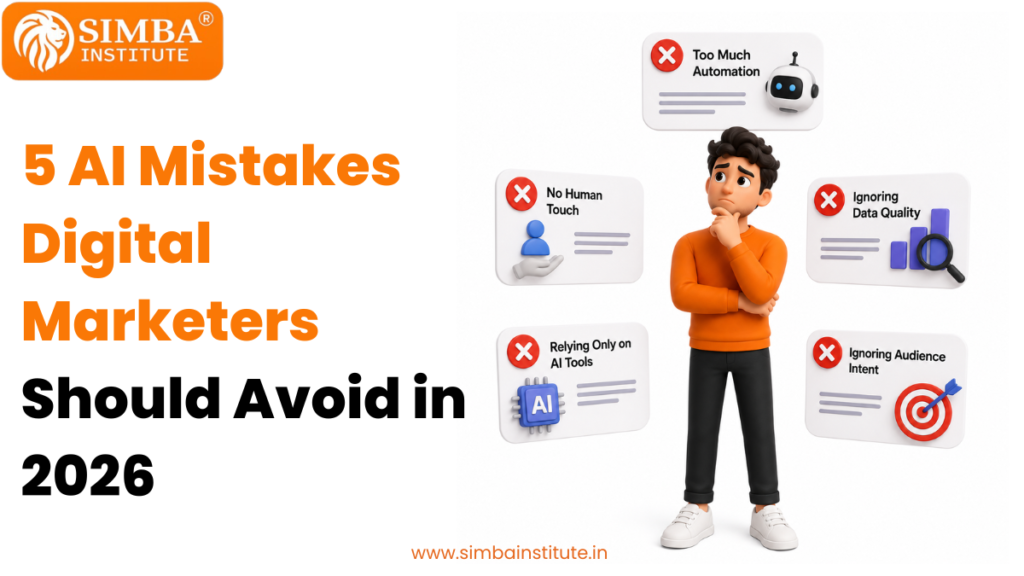
AI has made digital marketing faster and easier in many ways, but it’s also introduced a new set of mistakes marketers didn’t have to worry about before. Using AI tools well isn’t just about knowing how to use them, it’s also about knowing what not to do with them. This blog covers 5 common AI mistakes digital marketers make in 2026, why they hurt results, and how to avoid them, whether you’re a student just starting out or already working on real campaigns.   Why These Mistakes Matter More Than You’d Think It’s easy to assume that using AI automatically makes marketing work better. But used carelessly, AI can actually hurt campaign performance, damage brand trust, and make a marketer look less skilled, not more. The difference between marketers who benefit from AI and those who get hurt by it usually comes down to a few avoidable habits. Publishing AI Content Without Editing It One of the most common mistakes is taking AI-generated content, captions, emails, blog posts, and publishing it exactly as it was generated, without reviewing or personalizing it. AI-generated content often sounds generic, repetitive, or slightly “off” in tone, especially when it hasn’t been adjusted to match a specific brand voice. Audiences can usually tell when content feels automated rather than authentic, which can quietly hurt engagement and trust over time. How to avoid it: Always treat AI output as a first draft, not a final version. Edit for tone, accuracy, and brand voice before publishing anything. Relying on AI for Strategy Instead of Execution AI tools are excellent at speeding up execution, writing, designing, analyzing, but they’re not a replacement for strategic thinking. A common mistake is letting AI suggestions guide major decisions, like campaign direction or target audience, without applying human judgment based on actual business goals. AI can support decisions with data and suggestions, but it doesn’t understand a business’s unique context, goals, or long-term vision the way a marketer does. How to avoid it: Use AI to support your strategy, not replace it. Make key decisions based on your understanding of the brand and audience, using AI insights as one input among several. Ignoring Data Privacy and Accuracy AI tools often require inputting information to generate useful content or insights, and marketers sometimes overlook what data they’re sharing, or fail to verify that AI-generated claims and statistics are actually accurate before publishing them. Sharing sensitive business or customer information carelessly, or publishing inaccurate AI-generated facts, can create real problems — from privacy issues to damaged credibility if incorrect information is shared publicly. How to avoid it: Be mindful of what information you input into AI tools, and always fact-check any specific claims, statistics, or data points before including them in published content. Using the Same AI Output Across Every Platform Another common mistake is generating one piece of AI content and posting it identically across every platform, Instagram, LinkedIn, email, and website, without adjusting it for each platform’s audience and format. What works as a LinkedIn post rarely works as an Instagram caption, and content that isn’t adapted to each platform tends to underperform, regardless of how it was created. How to avoid it: Use AI to generate a strong base version, then adapt the tone, length, and format for each specific platform before publishing. Not Keeping Up With How AI Tools Are Changing AI tools are evolving quickly, with new features, capabilities, and best practices emerging regularly. A common mistake is learning one AI tool once and assuming that knowledge stays relevant indefinitely, without keeping up with updates or exploring new tools that could improve results. Marketers who stop learning quickly fall behind others who continue adapting to new AI capabilities as they become available. How to avoid it: Make it a habit to regularly explore updates to the AI tools you use, and stay open to trying new tools that could improve your workflow or results. What These Mistakes Have in Common Looking at all five mistakes together, there’s a clear pattern: they all come from treating AI as a replacement for effort and judgment, rather than a tool that supports it. The marketers who avoid these mistakes are the ones who stay actively involved in the process,  reviewing, personalizing, and thinking critically,  rather than letting AI run on autopilot.   Why Avoiding These Mistakes Matters for Your Career Employers and clients notice the difference between marketers who use AI thoughtfully and those who don’t. Avoiding these common mistakes doesn’t just improve campaign results, it also builds a reputation as someone who genuinely understands how to use AI well, which matters significantly when applying for jobs or managing client work. How Simba Institute Helps You Build These Habits Early At Simba Institute, our AI Tools course doesn’t just teach students how to use AI tools, it also focuses on how to use them responsibly and effectively, helping students avoid these common mistakes from the very beginning of their careers. The course covers practical, hands-on training with tools like ChatGPT, Canva, Midjourney, and various automation platforms, so students learn not just what these tools can do, but how to use them thoughtfully, editing AI output, verifying accuracy, and adapting content for different platforms and audiences, rather than publishing AI-generated work as-is. This kind of responsible, hands-on approach means students walk away with real, job-ready skills instead of just theoretical knowledge of AI tools. Whether it’s avoiding generic content, protecting data privacy, or knowing when to rely on AI versus human judgment, these habits are built into the course from day one, not treated as an afterthought Final Thoughts AI mistakes in digital marketing rarely come from the tools themselves, they come from how they’re used. Skipping edits, leaning too heavily on AI for strategy, or posting the same content everywhere without adjusting it are all avoidable habits, not unavoidable side effects of using AI. The marketers who get real value from AI in 2026 are the ones who stay involved in

5 AI Mistakes Digital Marketers Should Avoid in 2026 Read More »

Blog

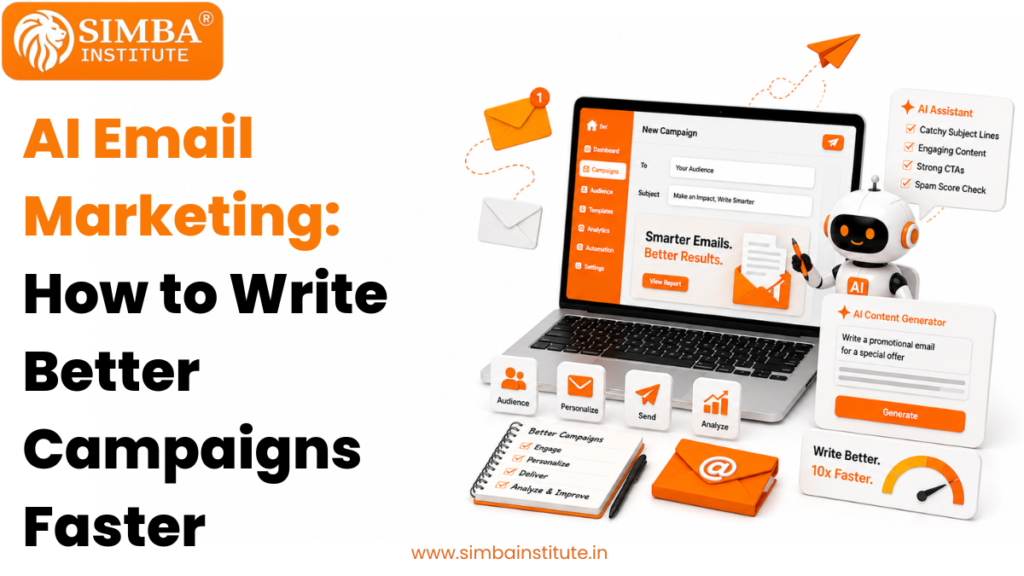
Email marketing remains one of the most effective ways to reach customers directly, but writing consistent, high-quality campaigns takes time, subject lines, body copy, follow-ups, and testing different versions. For marketers managing multiple clients or campaigns, this can quickly become overwhelming. This is exactly where AI has changed email marketing in 2026. Instead of writing every email from scratch, marketers now use AI tools to draft, refine, and optimize campaigns significantly faster, without losing the personal touch that makes email marketing effective. Why Email Marketing Still Matters in 2026 With so much focus on social media, it’s easy to assume email marketing has lost its importance. In reality, it remains one of the highest-return marketing channels available, since it reaches people directly, doesn’t rely on unpredictable algorithms, and works well for nurturing leads over time — something especially useful for course enrollments, business inquiries, and long-term customer relationships. The challenge has always been consistency: writing regular, engaging emails without it becoming a repetitive, time-consuming task. AI tools have made solving this challenge much easier. How AI Helps Write Better Email Campaigns Generating Strong Subject Lines The subject line determines whether an email gets opened at all. AI tools can generate multiple subject line variations in seconds, based on the email’s content and goal, giving marketers options to test instead of guessing what might work. Writing the First Draft Faster Instead of staring at a blank screen, marketers can describe what the email needs to communicate — a course offer, a follow-up reminder, an announcement — and let AI generate a solid first draft. This draft can then be edited and personalized to match the brand’s tone, rather than being written entirely from scratch. Personalizing at Scale Personalized emails perform significantly better than generic ones, but writing unique messages for different audience segments manually is time-consuming. AI tools can help generate variations of the same email tailored to different segments — students, working professionals, business owners — without multiplying the workload. A/B Testing Made Easier Testing which version of an email performs better used to require writing multiple versions manually and tracking results by hand. AI tools now make it easy to generate several variations quickly, so marketers can test subject lines, tone, or calls-to-action and identify what resonates most with their audience. Improving Tone and Clarity AI tools can also review and refine existing email drafts, suggesting clearer phrasing, better structure, or tone adjustments, helping ensure emails sound professional and easy to read before they’re sent out.   A Simple AI-Assisted Email Workflow Here’s a practical way to bring AI into your email marketing process: Define the goal — decide what the email needs to achieve (a course enrollment, a follow-up, a reminder) before writing anything. Use AI to draft the first version — generate a starting point based on the goal, rather than starting from a blank page. Edit and personalize — adjust the tone, add specific details, and make sure it sounds like your brand, not generic AI output. Generate subject line options — use AI to create a few variations, then pick or test the strongest ones. Review before sending — always read through the final version to catch anything that feels off or inaccurate.   Common Mistakes to Avoid While AI makes email marketing faster, a few habits can reduce its effectiveness: Sending AI-generated emails without editing — always personalize content so it reflects your actual brand voice and offer accurately. Ignoring your audience’s specific needs — AI can support writing, but understanding who you’re emailing should still guide the message. Skipping performance tracking — use open and click rates to understand what’s actually working, rather than assuming AI-generated content automatically performs well.   Why This Skill Matters for Digital Marketers Employers and clients increasingly expect digital marketers to manage email campaigns efficiently, without needing a separate copywriter for every send. Knowing how to use AI tools for email marketing, while still applying strategy and personalization, makes marketers significantly more valuable and capable of managing more campaigns without sacrificing quality. How Simba Institute Prepares You for This At Simba Institute, our Digital Marketing + AI Tools course includes practical training in email marketing alongside AI tool usage, helping students learn how to write effective campaigns quickly while understanding the strategy behind what makes emails actually convert. With branches in Sarthana and Vesu, and a track record since 2015, we focus on building skills that match how digital marketing is actually practiced by businesses today. Final Thoughts Email marketing hasn’t lost its value in 2026, it’s simply become faster and smarter to execute, thanks to AI. What used to take hours of writing, testing, and refining can now be done in a fraction of the time, without sacrificing the personal touch that makes email campaigns actually work. The marketers who benefit most from AI aren’t the ones who let it write everything for them, they’re the ones who use it to move faster, then add the judgment, personalization, and strategy that AI still can’t replicate on its own. If you’re managing email campaigns, whether for a business, a client, or your own brand, learning to work with AI tools isn’t optional anymore. It’s simply how effective email marketing gets done in 2026.   FAQs: AI Email Marketing 1. Can AI completely write email campaigns without any human input?AI can generate strong first drafts, but human input is still needed to personalize the content, ensure accuracy, and make sure it matches the brand’s voice and goals. 2. Will AI-generated emails feel robotic to readers?They can, if used without editing. The key is using AI as a starting point and then personalizing the tone and details so the email feels authentic. 3. Do I need technical skills to use AI for email marketing?No, most AI tools for email marketing are simple to use and require basic guidance rather than technical knowledge. 4. How can AI help improve email open rates?AI can generate and test multiple subject line variations

AI Email Marketing: How to Write Better Campaigns Faster Read More »

Blog
A student at Simba Institute participating in a practical, hands-on computer training session in Surat.

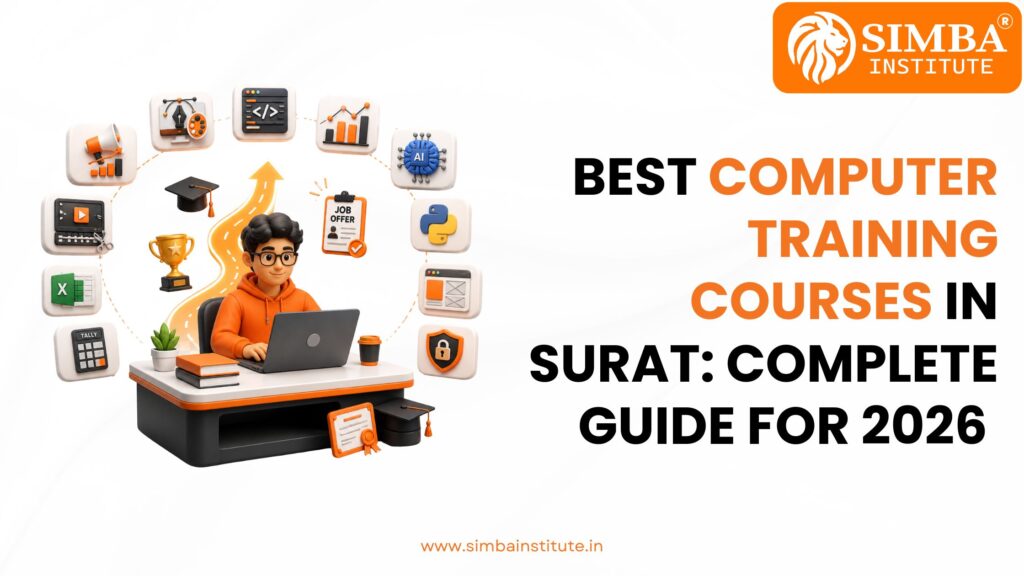
Do you want to enroll in the best computer training program in Surat to jump-start your career? Surat has emerged as a centre of good IT education and skill training. Whether you’re a beginner or a working professional, finding the right computer training course in Surat is crucial for your success. By 2026, there will be a variety of institutes with specialized programs that will help meet various levels of skills and career objectives. This is a detailed guide to steer you through the most appropriate ones. In addition, knowing what each course entails is a guarantee that you can make a better decision. The appropriate training will be able to change your future career opportunities and open new horizons. What Makes a Computer Training Course in Surat Stand Out? The main characteristics to consider are: How to Choose the Right Computer Training Course in Surat? In choosing a course of computer training in Surat, you must first consider your career objectives. Do you want to be at the entry level or in higher positions? Moreover, determine your level of skills and rate of learning. Besides, find out the reputation of the institute by checking reviews and testimonials. Types of Courses Available : What Should You Expect from Quality Training? An effective computer training course in Surat will entail a systematic curriculum of theoretical and practical information. Quality institutes offer new research materials and codes. Moreover, they also do regular assessments and mock interviews. They also provide post-course placement services. Mentor support and doubt-clearing sessions will stay the same. Training in soft skills makes you more employable. Seminars and workshops are sometimes held by industry experts. Real Examples: Success Stories from Surat Computer training has given many students an opportunity to change their careers. Rahul studied web development and got a job in a startup. Priya is a graduate of digital marketing, and she is the owner of an agency. Vikram is a working professional who went through evening batches and received a promotion. These tales demonstrate that quality training yields tangible outcomes. Besides, a number of institutes always have 80-90% of their students placed. The institutes of Surat boast of good industry contacts, which enable placements. Specification: Trends of 2026 Surat still has a high need for skilled IT professionals. Coding boot camps are becoming popular among career switchers. Premium salaries are paid to cloud computing and AI experts. The training of soft skills is becoming a part of programs. Hybrid classes are online and offline classes integrated. Institutions are concentrating on individualized learning courses. The industry alliances guarantee the relevance of the curriculum at all times. Final Thoughts The appropriate computer training course in Surat is an investment in the future. Quality training brings about good career prospects. Moreover, it provides you with the skills that are applicable in the current market. Do research on the institutes before making a decision. Check credentials, experience of the instructor, and placement history. Don’t compromise on quality for lower fees. The foundation you make today is the basis of your career growth. Ready to Transform Your Career? Get enrolled in a computer training course in Surat. Compare institutes, visit free demos, and make a good decision. The right decision now will allow you to succeed in your career in the future. There is nothing to wait—start your learning process now and open up a great universe. Frequently Asked Questions Q: What is the average price of a computer training course in Surat? A: Prices vary between 5,000 and 50,000 on the basis of the course duration and specialization. Principles are cheap, and higher qualifications are expensive. A lot of institutes have installment payments. Q: What is the average length of a computer training course? A: 1-3 months, depending on the type of basic course, and 6-12 months, depending on the advanced course. Batches that are intensive are quicker than ordinary timetables. Individual speed influences the total completion time. Q: Do all the courses have job placement services? A: Resume building and interview coaching are some of the placement support services provided by reputable institutes. Placement is, however, done based on performance and demand in the market. Placement records should be checked prior to enrollment. Q: Are working professionals allowed to take computer training classes? A: Yes, absolutely. The vast majority of institutes have evening and weekend batches that are targeted at professionals. The working schedule is suitable since it is flexible. Q: What are the most valuable certifications in 2026? A: AWS, Microsoft Azure, CompTIA, and Google Cloud certifications are appreciated. Online marketing qualifications also have a good demand in the market. Select according to your career objectives.

Best Computer Training Courses in Surat: Complete Guide for 2026  Read More »

Blog
Scroll to Top